- Follow us:


Goblet Squat Form: How to Squat Safely and Effectively
01/02/2026
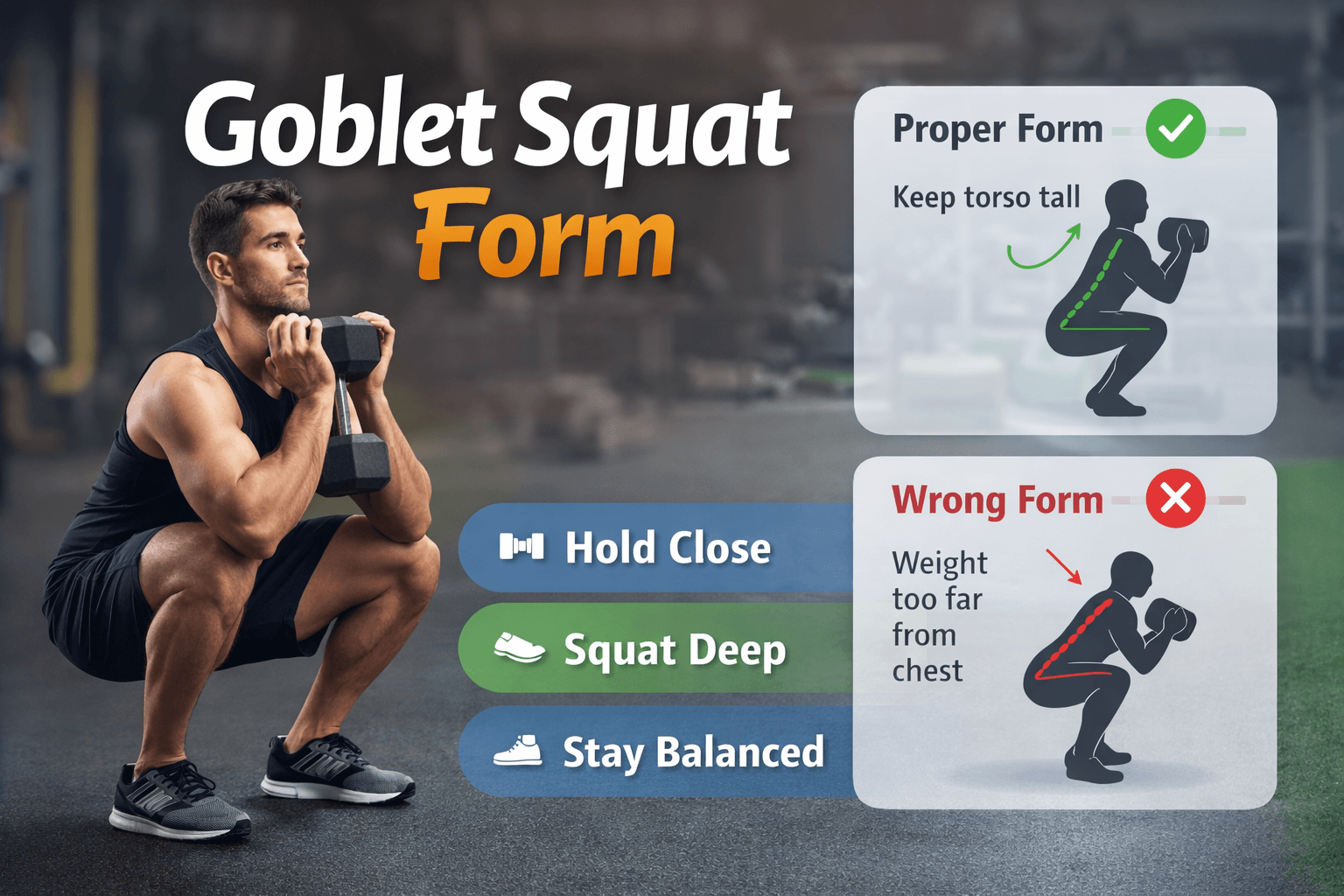
The goblet squat is one of the most beginner-friendly and joint-safe squat variations—but only when done with the correct goblet squat form. Poor technique can shift stress to the knees or lower back, while proper form builds strength, mobility, and confidence.
Whether you’re lifting for the first time or refining your technique, this guide breaks down the goblet squat step by step, explains common mistakes, and covers variations like the dumbbell goblet squat and elevated goblet squat.
Table of Contents
What Is a Goblet Squat?
A goblet squat is a squat variation where you hold a weight—usually a dumbbell or kettlebell—close to your chest while squatting. The front-loaded position naturally encourages better posture and depth.
Why Goblet Squats Are So Popular
- Easier to learn than barbell squats
- Improves squat depth and mobility
- Safer for knees and lower back
- Builds full-body strength
This makes goblet squats ideal for beginners, home workouts, and warm-ups for advanced lifters.
Goblet Squat Form: Step-by-Step Breakdown
1. Starting Position
- Hold a dumbbell vertically at chest height
- Elbows tucked slightly downward
- Feet shoulder-width apart
- Toes pointed slightly outward
Your chest should feel tall, not leaning forward.
2. The Descent
As you lower into the squat:
- Push hips back and down
- Keep knees tracking over toes
- Maintain a neutral spine
- Keep the weight close to your chest
Tip: Imagine sitting between your heels, not collapsing forward.
3. Bottom Position
At the lowest point:
- Thighs should be at least parallel to the floor
- Heels stay flat
- Chest remains upright
- Elbows may lightly touch inner thighs
This position reinforces proper goblet squat form and hip mobility.
4. The Ascent
To stand back up:
- Drive through your heels
- Engage glutes and core
- Keep chest lifted
- Fully extend hips at the top
Avoid locking your knees aggressively.
Dumbbell Goblet Squat Form Explained
The dumbbell goblet squat form is the most common variation and works perfectly for home gyms.
Key Dumbbell-Specific Tips
- Hold the dumbbell by one end (vertically)
- Keep wrists neutral, not bent back
- Use lighter weight to master depth first
Because the dumbbell sits close to your center of mass, it naturally improves balance and posture.
Elevated Goblet Squat Form
The elevated goblet squat form involves placing heels on a small plate or wedge.
When to Use It
- Limited ankle mobility
- Difficulty hitting squat depth
- Beginners struggling with balance
Benefits
- Easier depth
- Reduced forward lean
- Better quad activation
Caution: This is a temporary tool, not a long-term fix for mobility issues.
Common Goblet Squat Form Mistakes
1. Letting the Chest Collapse
This puts strain on the lower back and reduces effectiveness.
Fix: Keep elbows pointed down and chest tall.
2. Knees Caving In
This increases knee injury risk.
Fix: Actively push knees outward during the squat.
3. Heels Lifting Off the Floor
Usually caused by poor ankle mobility.
Fix: Slow the movement or try the elevated goblet squat variation.
4. Holding the Weight Too Far Forward
This pulls your torso down.
Fix: Keep the weight tight against your chest.
Muscles Worked in a Goblet Squat
Goblet squats are a full-body movement.
Primary Muscles
- Quadriceps
- Glutes
- Hamstrings
Secondary Muscles
- Core
- Upper back
- Forearms
Proper goblet squat form ensures balanced muscle engagement without excessive strain.
Goblet Squat vs Barbell Squat
| Feature | Goblet Squat | Barbell Squat |
|---|---|---|
| Skill level | Beginner-friendly | Intermediate–Advanced |
| Equipment | Dumbbell/Kettlebell | Barbell & rack |
| Spine load | Lower | Higher |
| Mobility demand | Moderate | High |
Goblet squats are ideal for learning squat mechanics before progressing to heavier barbell lifts.
How Many Reps and Sets Should You Do?
Beginners
- 3 sets of 10–12 reps
- Light to moderate weight
Intermediate
- 4 sets of 8–10 reps
- Focus on tempo and depth
Advanced
- Use goblet squats as warm-ups or mobility work
Form always matters more than weight.
Safety Tips for Perfect Goblet Squat Form
- Warm up hips, ankles, and knees
- Start with lighter weight
- Use a mirror or record yourself
- Stop if you feel lower back pain
A pain-free squat is a productive squat.
Want to know more about Goblet Squats? Read more here.
People Also Ask (FAQ)
Is goblet squat good for beginners?
Yes. Goblet squats are one of the safest ways to learn squat mechanics.
How heavy should a goblet squat be?
Use a weight that allows full depth without losing form. Technique comes first.
Can goblet squats replace barbell squats?
They can for beginners and home workouts, but barbell squats allow heavier loading long-term.
Why does my back hurt during goblet squats?
Poor posture, leaning forward, or holding the weight too far from the chest are common causes.
Are elevated goblet squats cheating?
No. They’re a useful progression tool, especially for mobility limitations.
Conclusion: Key Takeaways
Mastering goblet squat form builds a strong foundation for all lower-body exercises. Whether you’re using a dumbbell goblet squat or an elevated variation, focus on posture, depth, and control.
Remember:
- Keep the weight close
- Stay tall through the chest
- Move with control
- Prioritize form over load
A well-performed goblet squat trains strength, mobility, and confidence—all at once.
Our other blogs:
Explore more helpful guides to support a healthy lifestyle for your family.